This one did not

Oi, what’s the go with pants but?

Originally published by The Clifton Courier on June 17, 2020

Sometimes my housemate will do things that makes me wonder just what the heck goes on in his head. Like when he willingly opts to use a “dairy blend” instead of butter – you know, the kind of thing that makes you question his judgement, which in turn makes you question a whole lot of other things about who he is as a person.

But then he’ll come out with something that is so right on it stops you in your tracks. Or, in this case, trackies (this joke will make sense shortly, please bear with me).

He and my other housemate/his fiancé were heading out to get some dinner the other night after a day of working from the home office/the reconfigured dinning nook with a whiteboard on the wall. That meant working in comfy clothing. Sloppy joes. Slippers. Tracksuit pants (geddit?!).

But to brave the outside world, they had to change.

“How come the colour and material of clothing changes what you’re wearing so you’re appropriate for the public?” he said.

And holy geez, he was bang on.

During the day, he was wearing a pair of black trackies and a grey and black jumper. Together, they had a certain look. He looked comfy, but sloppy.
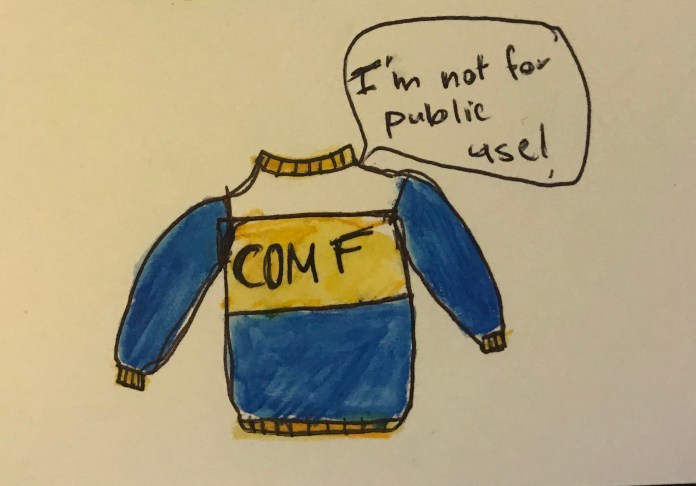
He walked out of his room after trading his trackies for a dark khaki colour pair of pants that had a stiffer weave, but wore the exact same jumper and suddenly he appeared somewhat polished.

In essence, he was wearing he same thing: pants and a jumper. But the pants were just a different fabric and colour.

In this instance, it was the fabric that changed his look from couch to the street: it would have been a similar vibe if the pants were the same colour – black – as he trackies.

But the pants, made of starchier material, were obviously more restrictive and less relaxed for some reason that made them way more appropriate for public wear than the sloppy trackies. It’s almost as if we – “we” being society – deem clothing more acceptable if they have an element discomfort.

It’s like how a loose, flowy crushed-linen button-up shirt doesn’t have the same professional polish as a fitted, crisply-ironed cotton polyester blend button-up shirt. In essence, they’re the same: a long-sleeved button-up shirt with a collar. But there’s one that’s more appropriate for a bougie barefoot picnic and another that would be better suited to a day in court.

However, it’s not just the fabric – colour comes into it as well.

Like how you go to a chain store and you see the same dresses in different colours. They could be the same fabric, but the colour of that fabric determines what occasions you can wear them to.

The one with three or four bright colours in some kind of technicolour pattern? That’s either for casual wear OR something to throw on before trotting off to da clubz to go dancing. Nothing is stopping you from wearing that multi-coloured speckled dress to a dressy brunch or the races, but you’d probably wear the white one instead. And you wouldn’t be fined for wearing that technicolour dream dress to work, or even a wedding, but you’re probably more likely to opt for the black dress, with its exact same fabric but more sophisticated air, instead.

Or, if we bring it back to pants, an office worker could rock could wear black jeans to the office any day of the week, but they’d probably only wear blue jeans on Casual Fridays. Why is that, when they’re the same fabric?

My housemate had made an incredibly astute observation, one that takes a lot to unpack.

I mean, you can wear trackies in public, but some pervasive voice tells us that it’s unacceptable. What is that? Where does it come from?

I mean, when it comes to fabric, I’m putting down to the level of effort you put in to dress yourself corresponding with how publically acceptable your attire is. As if sacrificing your comfort for the approval of strangers is a noble thing.

But the colour one baffles me.

I don’t have the answers just yet, but I am looking forward to bringing this up at me next social outings as a conversation starter – much like the classic “how is a burger different to a sandwich?” debacle.

Stand by for more musings on this.
Standard
This one made it to print

G’day g’day

Originally published by the Clifton Courier on June 10, 2020

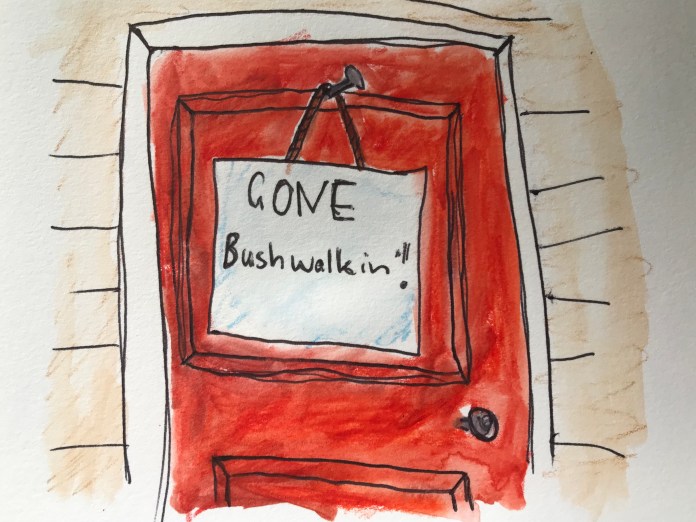
I love a good bushwalk.

I, like so many of my fellow cooped-up Queenslanders fangin’ for a bit of a freedom in These Uncertain Times, decided to take advantage of the glorious autumn weather and head out for a cheeky weekend bushwalk.

Now, before we go anywhere, I think it’s important to call it a bushwalk. It’s not a hike. I mean, it was a few kilometres, so I suppose you could reasonably describe it as “a fair hike” but, when it comes nouns, I prefer the term bushwalk. Perhaps I’m being patriotic or perhaps I’m being pedantic, but I feel like you can only refer to a bushwalk as a hike if you’re stepping on some significant inclines. I mean, I don’t think it needs to be a hard and fast rule with a cut-off. I’m not saying that all ventures where you’re dealing with an overall slope average of 15-degrees or fewer is a bushwalk and anything over 16 degrees is qualifies as a hike – it’s more the vibe of the thing. Plus, speaking of the vibe, “bushwalk” has much more of an Australian aura, whereas “hike” makes me think of characters on reality TV shows like The Hills going on a stroll around the Hollywood sign in expensive activewear. But it’s not just me being all anti-Americanisation – even though I find myself understanding my father’s deep hated of the use of the word “sweater” instead of jumper more and more – it goes beyond that. “Bushwalk” evokes the sound of whipbirds, the crunch of leaves underfoot, the land of sweeping plains and all that jazz. It’s not just about the act of walking; it’s about immersing yourself in nature and shouting out the random lines of bush poetry you remember from Grade 5.

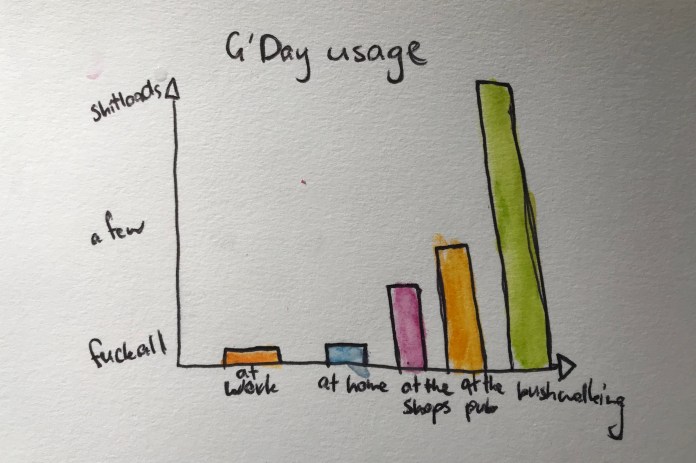
It also gives you a chance to drop a few g’days.

You really need to be prepared for a bit of a g’day action on the track.  The bushwalk from the other day was one of those tracks that looped back on itself, meaning you would pass people coming back the other way. It wasn’t bumper-to-bumper peak hour traffic, but it was fairly busy. Lots of people were coming past.

Usually, your standard bushwalking track isn’t much more than a metre wide, so passing someone can be fairly intimate. And if you lock eyes, you’ve got to do something to acknowledge that moment of connection.

I think most of us can agree that shooting out a cheeky little “g’day” with a nod of the head is the best course of action, even if you wouldn’t normally whip out a “g’day” in your day-to-day life.

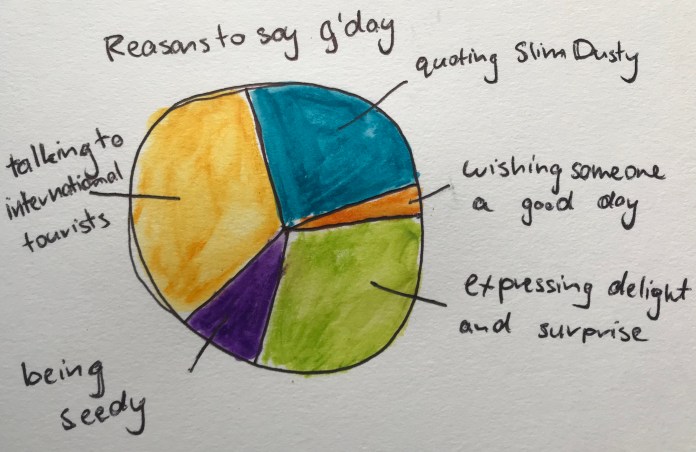
I’ll be honest, I don’t utilise that greeting in many other contexts. Sure, I’ll quote Slim Dusty’s G’day G’day, when confronted with something delicious, impressive or unexpected. For example, I might let out a growler of a “g’day g’day” after pulling a loaf of bread out of the oven. Or if I check on a the seeds I planted and see a few sprouts poking out of the soil. Or if I’m scrolling through my inbox and unexpectedly see a photo of a girl who was on the same Contiki tour as me modelling a tracksuit in an email I was sent by a sportswear brand I keep meaning to unsubscribe from. I use it as if to say, “well look at what we’ve got here”.

But I don’t use it for its intended purposes nearly enough.

That’s the beauty of the bushwalk, you connect with the rugged landscape, but you also get to tap into the stereotypical Aussie inside you, ready to tackle a croc or compare knives.

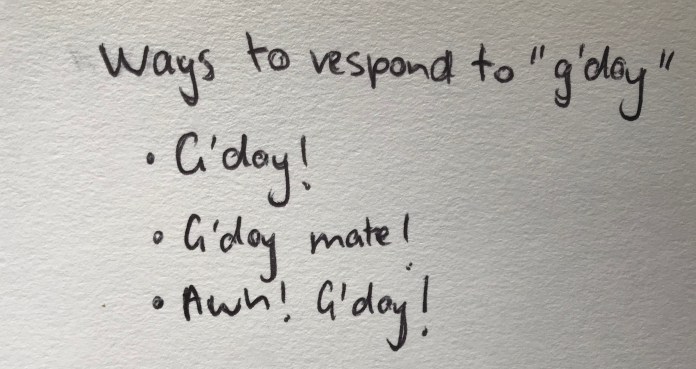
G’day just says so much. It says, “I acknowledge you as a person and I have general warm wishes towards you” but does so in the space of about 1.23 seconds. It’s short enough to get out so an oncoming bushwalker has enough time to fashion a response. And, let’s be honest, all it requires is an earnest “g’day” in return.

But you want to be the first person to speak when confronted with an oncoming bushwalker so you can establish the interaction as an exchange of g’days. You have to be ready to go, otherwise the other bushwalker might let out a “hey there” or, even worse, a “how’s it going?”, which leaves you on the back foot because you have to answer but don’t have enough time to ask how they’re going in return before they move on, and then it looks like you don’t care how they’re going, which makes you the worst bushwalker on the track.

So, if you’re about to go out for a bushwalk, make sure you apply sunscreen, wear a hat and back your water bottle. But, please, do not forget to have a couple g’days locked, loaded and ready to go. It’s critically important.


Standard
This one made it to print

Weak latte, strong spirit

Originally published by The Clifton Courier, June 3, 2020

Ok, so I’m a coffee drinker.

I’ve spoken about this before, which was a bit of a surprise to some of those in my inner circle who knew me as a strict tea drinker.

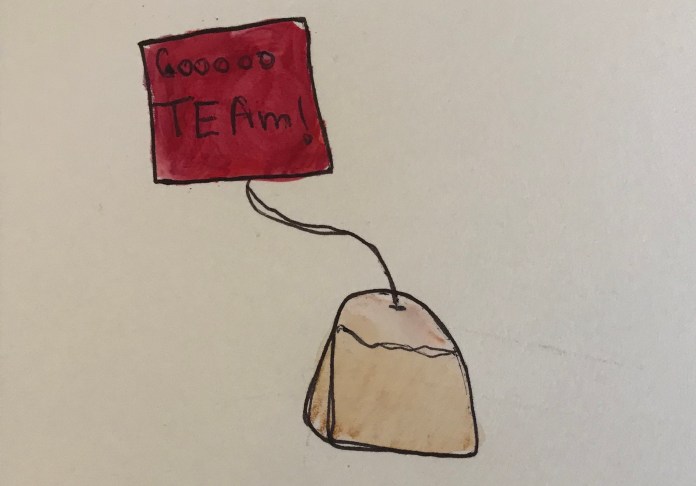
But I wouldn’t say that being a coffee drinker is part of my identity. I’m a long way off that. If I had to choose sides, I would of course be on the Tea Team (or TEAm, as we’d call ourselves).

And, in terms of coffee fiends, I’m pretty low rung.

This became apparent when I ordered a takeaway coffee not long ago. I gave the barista my usual order – “a large latte, but can I have that half strength please?” – after which they usually ask for a name to call out when my order is ready.

But on this particular day, they didn’t.

So when it came to the point where they had to call me to collect my warm, mildly-caffeinated milky beverage, they didn’t have a name to shout above the chattering masses. Instead, they could only call out my coffee order.

But instead of saying “a large latte but can I have that half strength please” they called out “weak latte”.

And let me tell you, I was taken aback.

I felt like retorting that, even though my latte was weak, I was a strong woman.

I’ve told a few people that story, any now there’s one cheeky person who, on their last coffee run, apparently insisted on the barista writing “weak latte” on my cup.

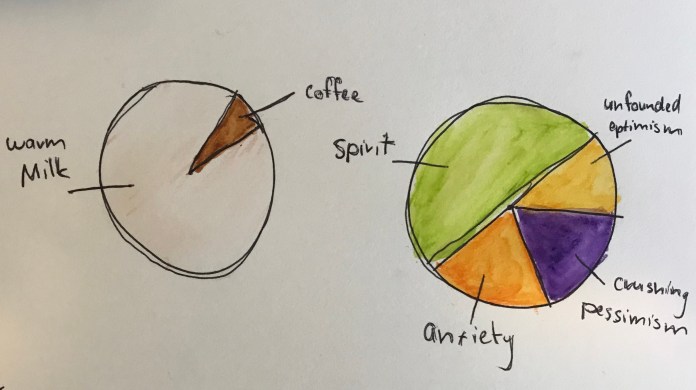
I went as far as to post it on Instagram, where I argued that the concentration of coffee in my warm milk didn’t correlate with the concentration of spirit in my soul. But there’s only so much you can put into a Instagram caption before you become a bit much. And, as someone who is routinely referred to as “a bit much” (which is a polite way of saying “geeez, I’m already sick of this person and her obnoxious carrying on”) in person, you really want to veer away from being “a bit much” on social media. That’s how you get yourself blocked.

But I still had more say and, because I can’t go to the pub and therefore can’t have a boozy heart-to-heart with the unfortunate Uber driver charged with getting me home, I’ve decided to do so via this column.

I think it’s important to point out that I don’t drink coffee because I need it. I like the taste and I enjoy the sensation of a hot coffee cup in my hand. I like the grown-up aura drinking a coffee gives me. I enjoy the feeling of importance I get from going out for a coffee run and others entrust me to supply their caffeine. It’s kind of like playing offices, which was my favourite game as a child.

I like coffee, but I don’t NEED it.

Back in the day, I used coffee exclusively to get me through long, late-night drives in my uni days, when I needed to get back to Clifton after being kept awake by assignments and… other uni-related activities. It was a sleep repellent and nothing else.

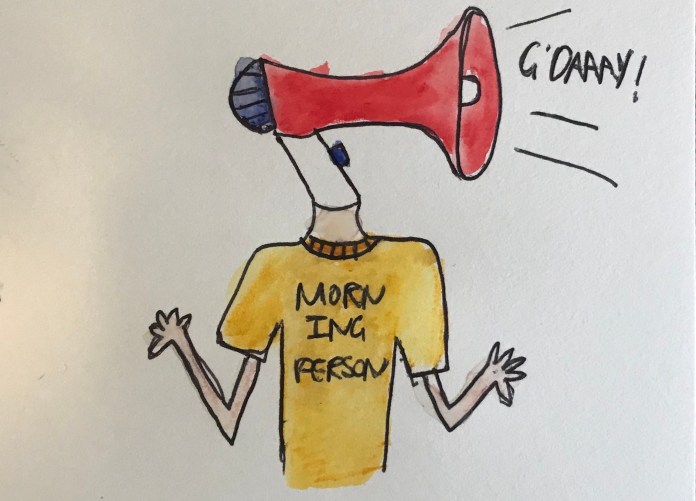
But I’m not one of those people who desperately needs a coffee to get them going in the morning. Some people need coffee to give them that spark, the spring in their step. But I, as I’ve learned after years in various office and early-morning burger-selling settings, I don’t need coffee. Because I’m one of those Morning People.

Again, a Morning Person is a polite way of describing someone insufferably obnoxious, but with the added annoyance of being chirpy, alert and, worst of all, enthusiastic about life, in the early hours of the day.

My Morning Person-ness becomes extra apparent to those colleagues of mine lucky enough to be on shift with me at 4.30am*. And, hey, even as a Morning Person, I have to admit that starting at 4.30am can be tough. So when you’re Not a Morning Person starting work at 4.30am and the Morning People are within earshot, flapping about with their unwarranted joy and diabolical energy, it would be pretty hard to stomach.

* The other day my chirpy greeting was compared to the great Frank Walker, of National Tiles fame. And they weren’t wrong. That’s the kind of pep they’re slapped with early in the day. And it’s almost like the earlier it is, the peppier I get. Because when it’s earlier, it’s harder to be alive and it’s almost like I feed off this grimness as an act of defiance. I’m sure there’s some kind of legitimate psychological reasoning behind it, but for now I like to put it down to the classic Queenslander underdog complex kicking in. 

Adding coffee to that energy seems like it would be extremely reckless.

So I suppose that, by getting a weak latte, I’m not only protecting myself from a caffeine addiction, but I’m also doing a public service.

I guess that means I’m some kind of hero?


Standard
This one did not

What’s in a LOL?

What is the best way to communicate genuine laughter?

I mean, obviously I’m talking in a text-based scenario. Because, clearly, the act of laughing would be the best way to express your amusement in a face-to-face conversation.

But when you’re in a back-and-fourth text exchange, you can let out a belly laugh but the other person won’t hear it. If you want someone to know that you genuinely found their last remark amusing, you have to literally spell it out. But spelling it out is tricky.

The first option is the standard “haha”. It’s what most people would interpret as laughter, even though it doesn’t really reflect any living human person’s actual laughing style. It is, I would say, the generic depiction of laughter across all English-speaking countries. And that’s all well and good, but because it’s so widely-used, it doesn’t come off as all that authentic. It’s kind of like when you were one MSN back in the day and typing “LOL” even though you were silently staring at the computer screen with a straight face – because, even if you did have to try to be quiet so as to not wake up your parents with your rollicking laughter, most of the time the other person’s banter did generate an actual laugh out loud response.

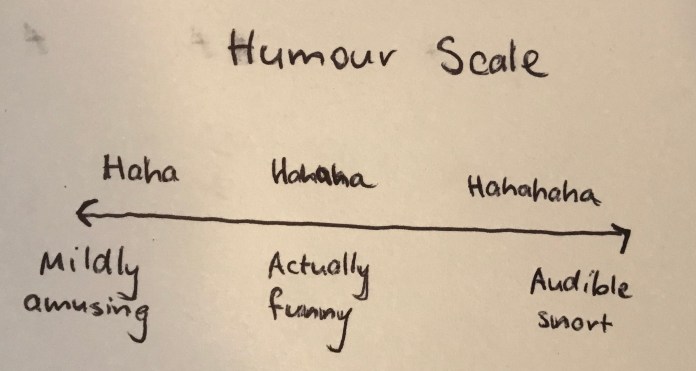
So what about a “hahaha”? I mean, that’s one extra “ha” and it’s different to the standard “haha”, so it seems to have more weight to it. But, then, I feel like adding extra “ha”s on to a “haha” then creates some kind of hierarchy of laughter. Like, it’s as if you have a scale for your level of amusement and, having assessed the humour of the previous remark against it, came to the conclusion that it deserved one extra “ha”. Whereas other jokes might get a “hahahaha” – that’s two extra “ha”s – because your analysis of the joke generated a higher laughter score. And, look, that might be good at communicating the humour of the joke but, again, it doesn’t have the authenticity of a good laugh.

Because it’s kind of saying “after careful consideration I’ve scored that joke and determined that it warrants X number of ‘ha’s, well done”. So it’s like you’re almost grading the person instead of simply responding with amusement. You’ve had to stop, think and then type out your laughter accordingly and it’s highly likely you’ve looked at the number of “ha”s you’ve written and edited it according to your initial humour assessment. This makes it pretty contrived, when genuine laughter is typically an involuntary response.

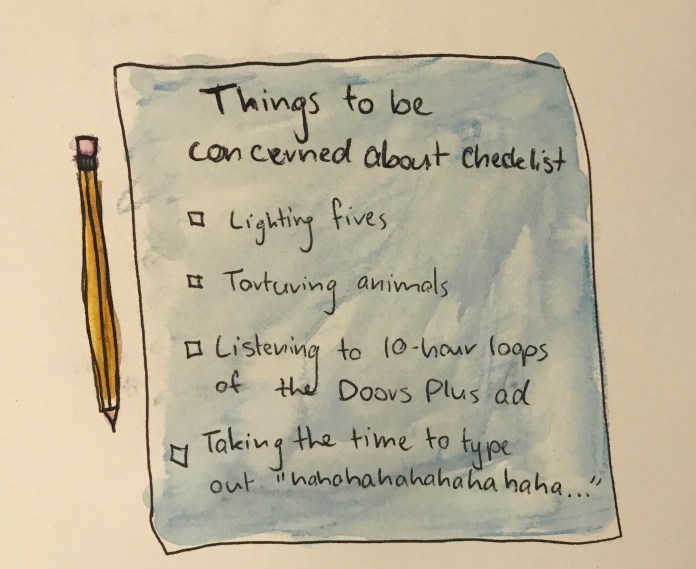
And, at the same time, you have to wonder how many “ha”s are too many. Like, where do you draw the line between laughter and straight up mocking? Because if you see a hahahahahahahahahahahahahahahahahaha, it goes beyond laughter and ventures into something more menacing. I mean, who spends that much time typing that out? Who in their right mind would do that? Excessive use of the “ha” conveys something else entirely.

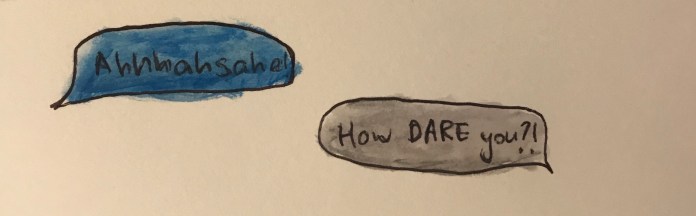
So should you then just chuck down a splutter of letters, messily assembled to convey your amusement? Something like “ahshahha”? Surely that looks more genuine, right? I mean, I kind of think so but then, I just wrote that while lying silently in my cold bedroom, nursing a headache with what I can only assume is a dumb, blank look on my face. I wasn’t laughing at all, but it kind of looks like I was. And this might be worse than the “ha” scoring system I talked about above, because the random smattering of “ha”-like letters is entirely false. You could argue the doubling up of an “h” and the addition of the “s”, which is close to the “a” on the keyboard, was an unintentional consequence of my feverish typing which I was unable to control due to my uncontrollable laughter, but it wasn’t.  I added the typos in to make the laughter look more genuine. And this deception actually makes it feel more fraudulent to me. That’s not laughter, that’s a betrayal of trust.

So what do you do you when you genuinely find something amusing and you want the other person to know that?

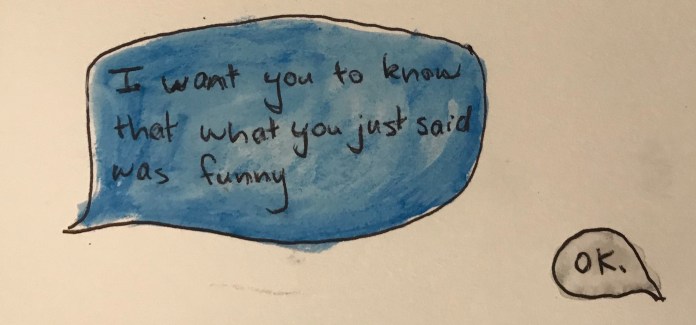
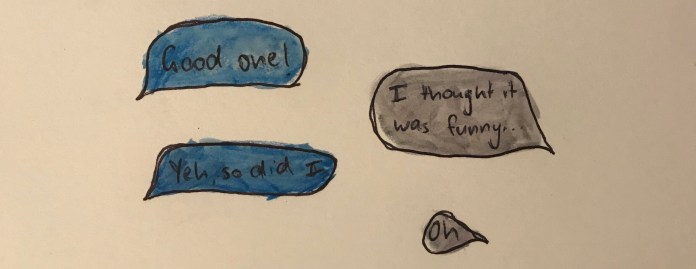
Sometimes I’ll chuck out a “hah”, which by its very nature is quite contrived. I mean, think of the last time someone let out a “hah” in conversation, without any follow up laughter – I’m wiling to bet it was a deliberately engineered response, used to convey something mixed in with the laughter, like disapproval or a hint of disdain. Other times I’ll say “that was a good one” but there’s the risk of it being misinterpreted as sarcasm because the phrase “good one” is so frequently used in movies and shows to show that a character does not actually think the “one” in question was good at all. I’ve also seen some people go with a “that was funny”, but there’s still a lot of misinterpretation that could go on there. You could also like the comment – like, on Instagram, it puts a little heart on the speech bubble – but then, what does that say about the other messages you haven’t liked?

I hoped I’d get to the end of this with a resolution, but I actually don’t know the answers to this one. The best I can come up with is that it’s a case-by-case kind of thing – which means you have to adjust your expressions of amusement according to the context and tailor your response for each individual person like you’re actually engaged in the conversation with them or something. Or should you describe what your bodily response to the joke was? Like, “I actually just literally laughed out loud”? Or maybe a “I just snorted”? Or a “I actually just peed my knickers and now I’ve been sent home from work”? If you have the answers, please respond with your preferred authentic but contrived combination of letters that you use to express your level of amusement.

Standard
This one made it to print

There’s “right” and then there’s “right”

Originally published in The Clifton Courier, May 27, 2020

Ok, so driving with me is a bit of an experience.

But, then, driving with anyone is a bit of an experience. Because, if you pay attention, the way someone acts behind the wheel can be quite revealing about what is going on in the thinnkbox atop someone’s neck.

The most obvious is the selection of music. You can learn a lot about a person based on their playlists. With me, you have the depressing indie songs that allude to my pretentiousness. There’s the Fleetwood Mac, which suggests I’ve reached a certain level of maturity in my late 20s where I crave easy listening music. The selection of a few specific Top 40 songs that say I’m aware enough about current trends to be relevant, but not so obsessed with them that I’m mainstream. And then you have the sprinkling of Lee Kernaghan to communicate my regional town roots but complete lack of agricultural knowledge – in case the clean Akubra and liberal use of the word “mate” didn’t already drop that hint.

You also get a glimpse of the rage that bubbles underneath my serene (it’s serene, right… right?!) exterior by my angry commentary of the drivers behaving like absolute roo heads in front of me. I mean, I’m not someone who hangs out of the car screaming obscenities at people and shake my fists or anything.  I don’t want the other drivers to know I’m taking about them, so I am usually quite restrained in my body language. My style of road rage is more like a stream of consciousness kind of a thing – I’m more of a mutterer, kind of like I’m hexing someone under my breath.

But perhaps the best insight into the way I think is when people are giving me directions.

When I’m driving by myself, I usually stick to the same routes I’ve travelled before as I click into a focused but somehow also absentminded autopilot mode. I tap into a way of thinking that feels more instinctual than analytical. More humanities than science. More art than maths, ya know?

Like, I go by feel, not by following steps.

Kind of like how learning a dance by breaking it down into tiny steps feels impossible and silly, but breaking out an interpretive number on the dance floor is completely natural.

That’s like how I drive.

I mean, people can say “turn right” but what does that actually mean, you know?

This is the part where I level with you.

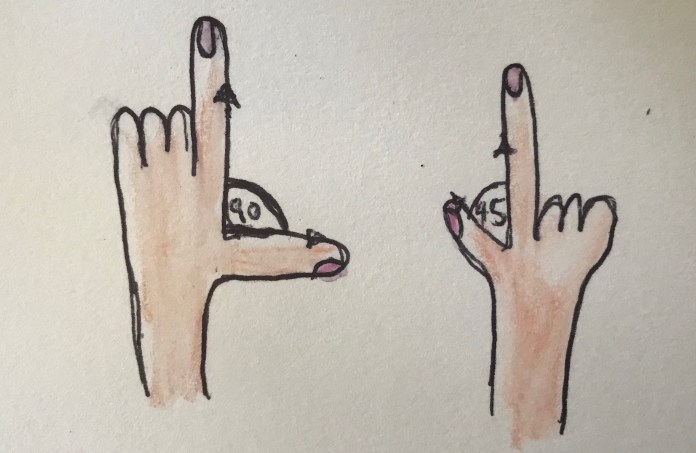
I’ve always had trouble with my lefts and rights. It’s just never been my thing. Like, you know that thing where you make an L shape with your index finger and thumb on both hands and the one that looks like an L is your left hand? Well, for the longest time, I just thought the angle of the left hand fingers was closer to the 90-degree corner angle than your right hand, therefore making it a better L shape. It just didn’t occur to me that one of the Ls was back to front.

Maybe it’s dumb, but maybe it’s an example of my brain just not confirming to the boxes of society, man. Like, maybe it’s not that I don’t know my left from right, but that I transcend lefts and rights.

And maybe me needing to go for my Learners’ test four times because I kept mixing up my lefts and rights was a journey I needed to go on because I still had unfinished business on the school bus that I couldn’t have completed if I was behind the wheel of a car, you know?

So, with all this in mind, I’ll describe a recent scene when I was driving with a first-time passenger who directed me to turn right and was flummoxed when I changed lanes to turn left.

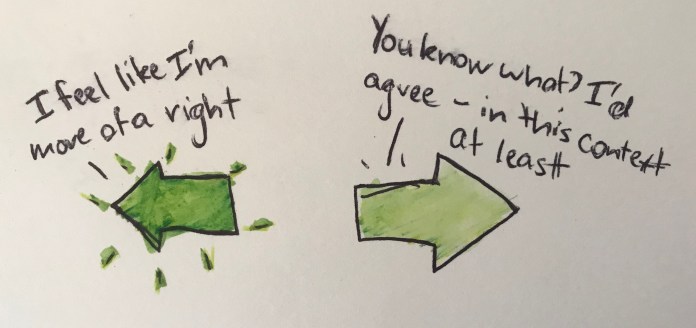
I had to explain that, sometimes, it just doesn’t occur to me that left is left or that right is right. That it’s more of the vibe of the thing and that, sometimes, the left direction just has more of a righthand vibe, you know?

It’s been a little while now and that first-time passenger hasn’t become a second time passenger yet.

I’m not really sure why.

Standard