
Originally published by the Clifton Courier December 18, 2019
Look, this is called a fruitcake, but I’m reluctant to call it that.
The cake does have fruit in it, so the name is technically correct, but the connotations surrounding it aren’t great.
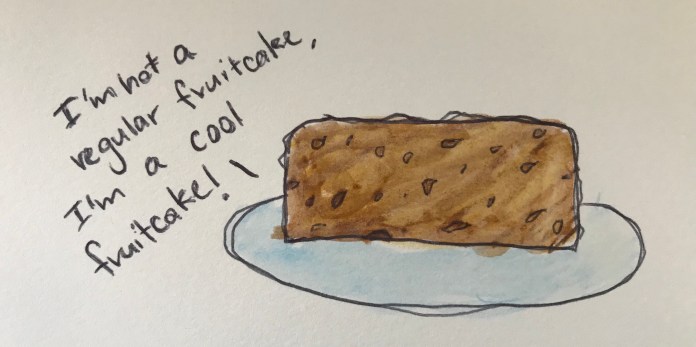
Fruitcakes get a bad wrap. When you mention fruitcake to other people, they get flashbacks of dry, underwhelming Christmas cakes and retro wedding cakes with chalky marzipan.
As someone who has also been looking forward to cake only to realise it’s a thick-iced slab of fruity disappointment, I understand that.
But this fruitcake is different.
For one, it has pineapple in it. Secondly, it doesn’t remind you of carpet underlay – my extremely sceptical housemate loved it, commenting that it’s not as dense as normal fruitcake. “It’s not really a fruitcake, it’s like a normal cake,” he said, entirely unprompted.
It’s Mum’s signature fruitcake, which I believe came from something of a bible for many around her age: The Day to Day Cookery.
It keeps really well, so it’s a great cake to make as a present. Or to take to a morning tea. Or to keep in the freezer for when you need some comfort food. It’s even become something of a currency in the same way a carton of beer can repay someone’s services, but this has a bit more heart.
I made this once before a few years ago to take along to an interview with our then Deputy Prime Minister in case the conversation got awkward (that cake subsequently featured on the front page of the Armidale paper, so it’s kind of a big deal).
But I never have cause to make this cake because Mum usually has one on the go.
However, since it’s Christmas, and people are often saddled with bad fruitcakes at this time of the year, I wanted to offer an alternative to the traditional dense slabs of fruity “meh”.
Step one: Measure out the saucepan ingredients.
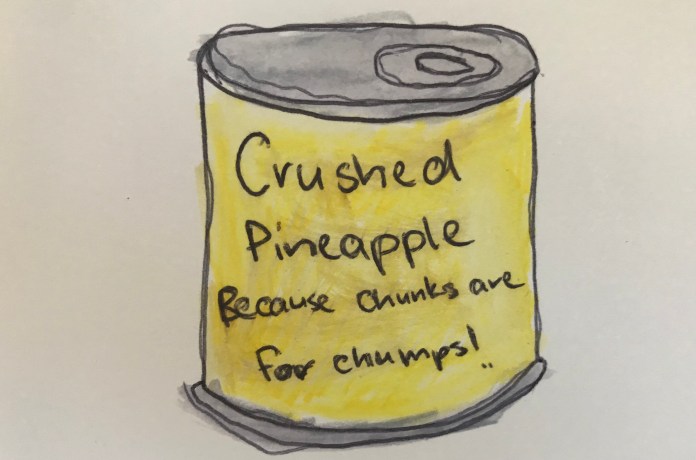
Mum’s recipe – which she tweaked and wrote out by hand – calls for a 450 gram can of pineapple. This must be Golden Circle and it must be crushed pineapple, not chunked. You don’t want the pineapple to be noticeable; it’s pretty much invisible in this recipe because it boils down into a syrupy secret. Sadly, the pineapple tins now only come in 440 grams, which might be a reflection of the times.
Then you need 375 grams of mixed fruit, the Sunbeam kind. DO NOT get any other brand. Dad did this once and we all suffered for it. It just wasn’t the same. Get the brand-name fruit, for the love of all things holy. I don’t have kitchen scales, so I had to do a bit of maths to work out how many cups to add. I measured out the one-kilo bag in cups and learned there were roughly five of them. From there I did a bit of algebra (YES IT IS USEFUL IN REAL LIFE) to work out that I needed one and three-overloaded-quarters of a cup of this fruit. You also need one cup of sugar, 125 grams of butter, half a teaspoon each of ground cinnamon and nutmeg, a teaspoon of mixed spice (but I used allspice because I’m rebellious) and a teaspoon of bicarb soda.
Step two: Mum says you should then bring this to the boil and “turn it back to just boiling” – don’t ask me what number you should the burner down to, because it seems to be more of an intuitive thing. The bicarb soda starts frothing up like when you add vanilla ice cream to a glass of coke and the whole thing bubbles up like a murderous blob coming for you. Mum says to stir occasionally to stop the mixture sticking to the bottom, but I am stirring to keep this froth from eating my soul.

Step three: Turn on the timer for exactly 10 minutes, taking the saucepan off the heat when it goes off.
Step four: While waiting for the mixture to cool, sift one cup of plain flour, a pinch of salt and one cup of self-raising flour together. Mum usually sifts this into the dish she’ll back the cake in after she’s lined it with baking paper. You mix everything together in the saucepan, so don’t make more washing up by tipping this into a bowl. Also, beat two eggs and put aside.
Step five: It was about this time Mum called to check to see how things were going. I asked her how cool the mixture should be and she couldn’t give me a straight answer. We worked out it should be cool enough to stick your finger in without screaming, which is a risky testing method. “I don’t usually put my fingers in,” she assures me. She then says it depends on the weather. “There’s no hard and fast rules – leave it for quite a bit,” she said. “You should be able to touch the outside of the saucepan.” Or, if you don’t want to risk burning yourself, leave it to cool for half an hour.

Step six: Stir in the egg.
Step seven: Gradually add the salty flours into the saucepan, stirring as you go.
Step eight: Mum usually pours this into a square baking tin, but we only have a loaf tin. There’s a specific way Mum cuts slices of the cake and I’m worried a rectangular shape will through everything off and the universe will implode.
Step nine: Bake at 160 degrees for an hour, being sure to skewer test it before you turn the oven off.
Step ten: After it has cooled in the tin, slice and then force-feed to your cynical housemate slathered in butter.

 Just a Thought